



How it works: one molecule, three receptors
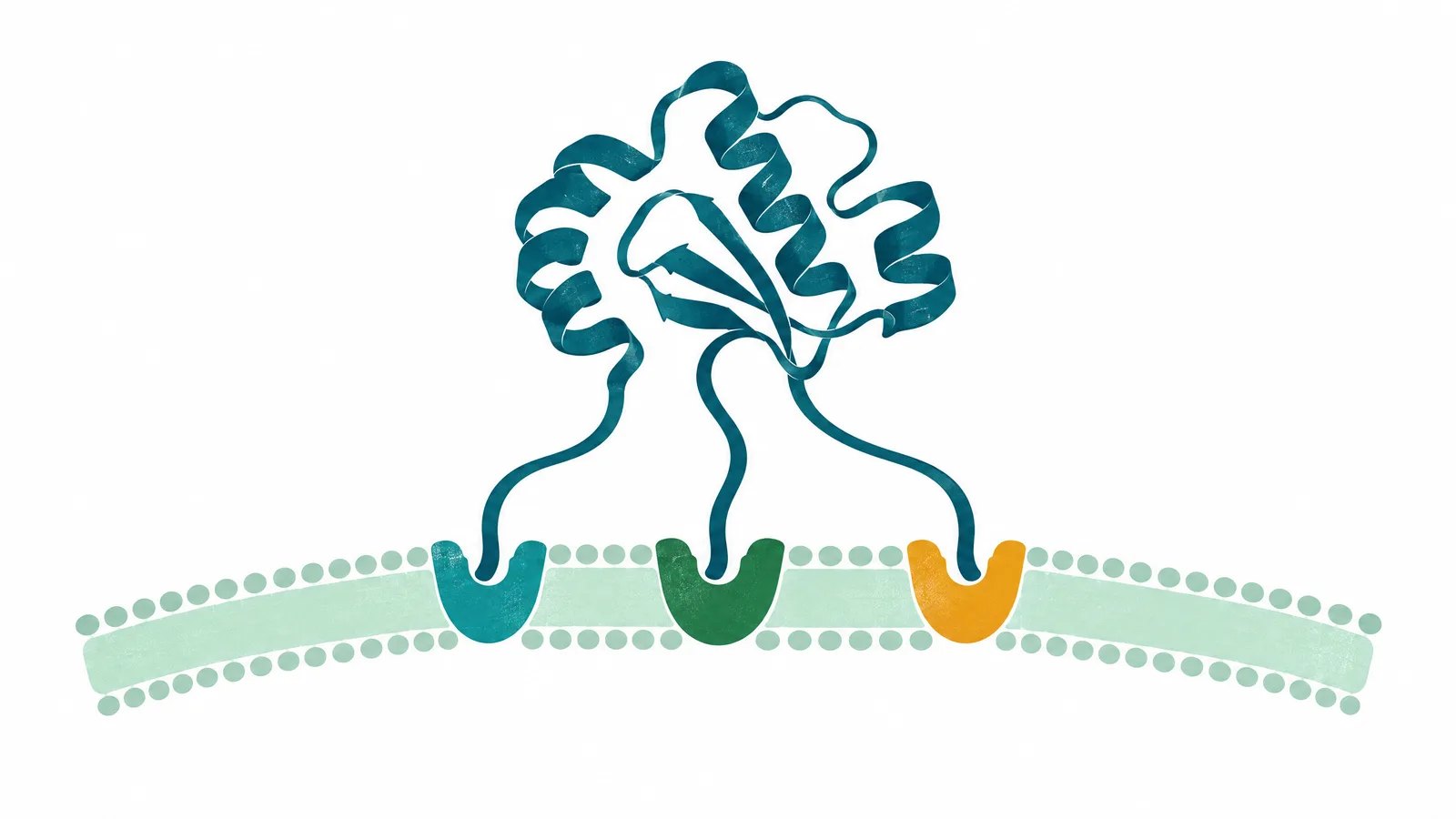
Retatrutide is a single 39-amino-acid peptide built on the backbone of GIP, a gut hormone, and modified so that the same chain also fits the GLP-1 receptor and the glucagon receptor. A fatty diacid keeps it in the blood for about six days, which is why it is injected once a week[1][2].
Each receptor does a different job. GLP-1 receptor activation slows the stomach, lowers appetite and increases insulin only when glucose is high. GIP receptor activation reinforces the insulin effect and, combined with GLP-1, appears to improve tolerability and add to the body-weight effect.
Glucagon receptor activation raises energy expenditure and pushes the liver to burn fat.
The discovery paper in Cell Metabolism describes how the potency at each receptor was tuned, with GIP activity strongest and GLP-1 and glucagon activity set at a fraction of the native hormones, so that the incretin effects outweigh glucagon's tendency to raise blood sugar[1].
- GIP receptorInsulin
- GLP-1 receptorAppetite
- Glucagon receptorEnergy
The same map as a table, with the approved drugs that share each receptor:
| Receptor | Main effect | Also targeted by |
|---|---|---|
| GIP | Insulin release, fat tissue signalling | tirzepatide |
| GLP-1 | Less appetite, slower stomach, insulin when glucose is high | semaglutide, tirzepatide |
| Glucagon | More energy burned, liver fat cleared | no approved obesity drug |
Receptors and effects
The clearest fingerprint of the glucagon component is in the liver: in the phase 2 substudy of 98 people with fatty liver, liver fat fell by more than 80% in 24 weeks on the 8 mg and 12 mg doses while body weight had fallen by about 17%[5].
People call it reta because retatrutide is long, and GLP-3 because it acts on three receptors where semaglutide acts on one and tirzepatide on two. Neither nickname is a product name.
There is no approved retatrutide medicine anywhere, and every product sold under these names today is either laboratory reagent or an unapproved drug. We explain the nicknames in what is reta and GLP-3 peptide. The same explainer exists en français, auf Deutsch, po polsku and en español.
What the trials showed
Two published phase 2 trials and four phase 3 read-outs, from 338 people to 2,339. The table below lists them; the text explains what each one measured.
| Trial | People | Top-dose result |
|---|---|---|
| Phase 2, obesity (NEJM 2023) | 338 | −24.2% at 48 wk |
| Phase 2, type 2 diabetes (Lancet 2023) | 281 | −16.9% at 36 wk; HbA1c about −2 pts |
| TRIUMPH-4, knee OA (Dec 2025) | 445 | −28.7% at 68 wk |
| TRIUMPH-1, obesity (May 2026) | 2,339 | −28.3% at 80 wk |
| TRIUMPH-2 and 3 (Jul 2026) | 1,152 and 1,949 | −20.8% and −22.6% at 80 wk |
The retatrutide trials
Phase 2: the 48-week obesity trial
Published in the New England Journal of Medicine in 2023, the phase 2 obesity trial enrolled 338 adults with obesity or overweight and no diabetes.
Mean weight change at 48 weeks was −8.7% on 1 mg, −17.1% on 4 mg, −22.8% on 8 mg and −24.2% on 12 mg, against −2.1% on placebo, and the curves had not flattened when the trial ended[3].
Figure 2
A parallel trial in 281 people with type 2 diabetes, in The Lancet, found HbA1c reductions of about two percentage points on the higher doses at 24 weeks and weight change of −16.94% on 12 mg at 36 weeks[4].
Phase 3: the TRIUMPH program
Five phase 3 trials were registered under the name TRIUMPH from 2023, and four have reported. TRIUMPH-4, in 445 adults with knee osteoarthritis, reported −28.7% at 68 weeks on 12 mg in December 2025[9].
TRIUMPH-1 (NCT05929066), the pivotal obesity trial in 2,339 adults, reported on 21 May 2026: mean weight change at 80 weeks of −19.0% on 4 mg, −25.9% on 9 mg and −28.3% on 12 mg, against −2.2% on placebo; 45.3% of the 12 mg group lost at least 30% of their body weight, and an extension in people with a BMI of 35 or more reached −30.3% at 104 weeks[6][7].
TRIUMPH-2 (diabetes) and TRIUMPH-3 (cardiovascular disease) reported −20.8% and −22.6% at 80 weeks on 12 mg in July 2026[8].
Figure 3
For scale, semaglutide 2.4 mg produced −14.9% at 68 weeks in STEP 1[12] and tirzepatide 15 mg produced −20.9% at 72 weeks in SURMOUNT-1[11]. These are separate trials, not head-to-head comparisons; the caveats are in retatrutide vs tirzepatide.
Side effects
Gastrointestinal, dose-related, and concentrated during dose escalation.
In TRIUMPH-1 the most common adverse events on 4, 9 and 12 mg versus placebo were nausea (28.6%, 38.4%, 42.4% versus 14.8%), diarrhoea (25.2%, 34.1%, 32.0% versus 13.5%) and constipation (23.8%, 25.9%, 26.1% versus 10.9%); discontinuation for adverse events was 4.1%, 6.9% and 11.3% versus 4.9%[6].
The phase 2 trial also recorded a dose-dependent rise in heart rate that peaked around week 24 and then declined[3]. The cardiovascular outcomes trial that will say whether that matters, TRIUMPH-Outcomes, runs to about 2029[10].
The full record, every adverse event the trials logged, dose by dose, is on our sister site Retatrutide Risk.
Approval status
No. Retatrutide has no marketing authorisation from the FDA, the EMA or any other regulator.
In its 23 July 2026 announcement Lilly said it plans to submit a Biologics License Application to the FDA in the first quarter of 2027[8]; a standard review takes about ten to twelve months from acceptance, so a decision before late 2027 is unlikely.
Until then there is no approved dose, no label and no prescription route, and posts claiming otherwise are wrong, as we detail in retatrutide on Reddit and retatrutide FDA approval.
Where to get it
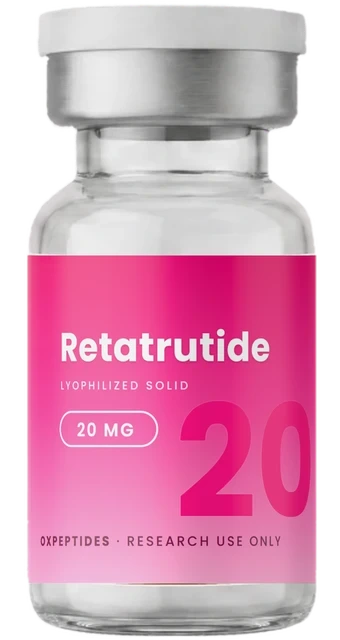
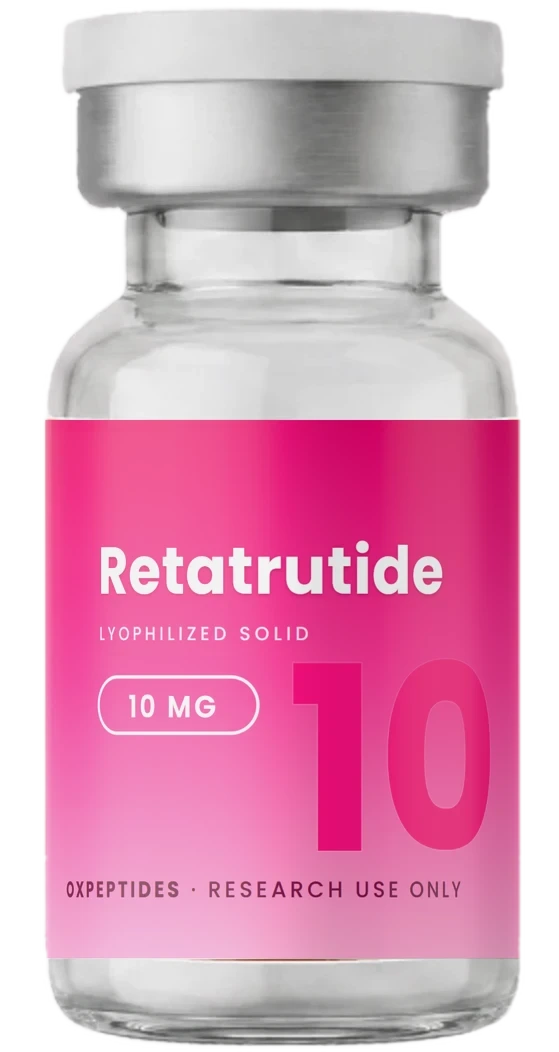
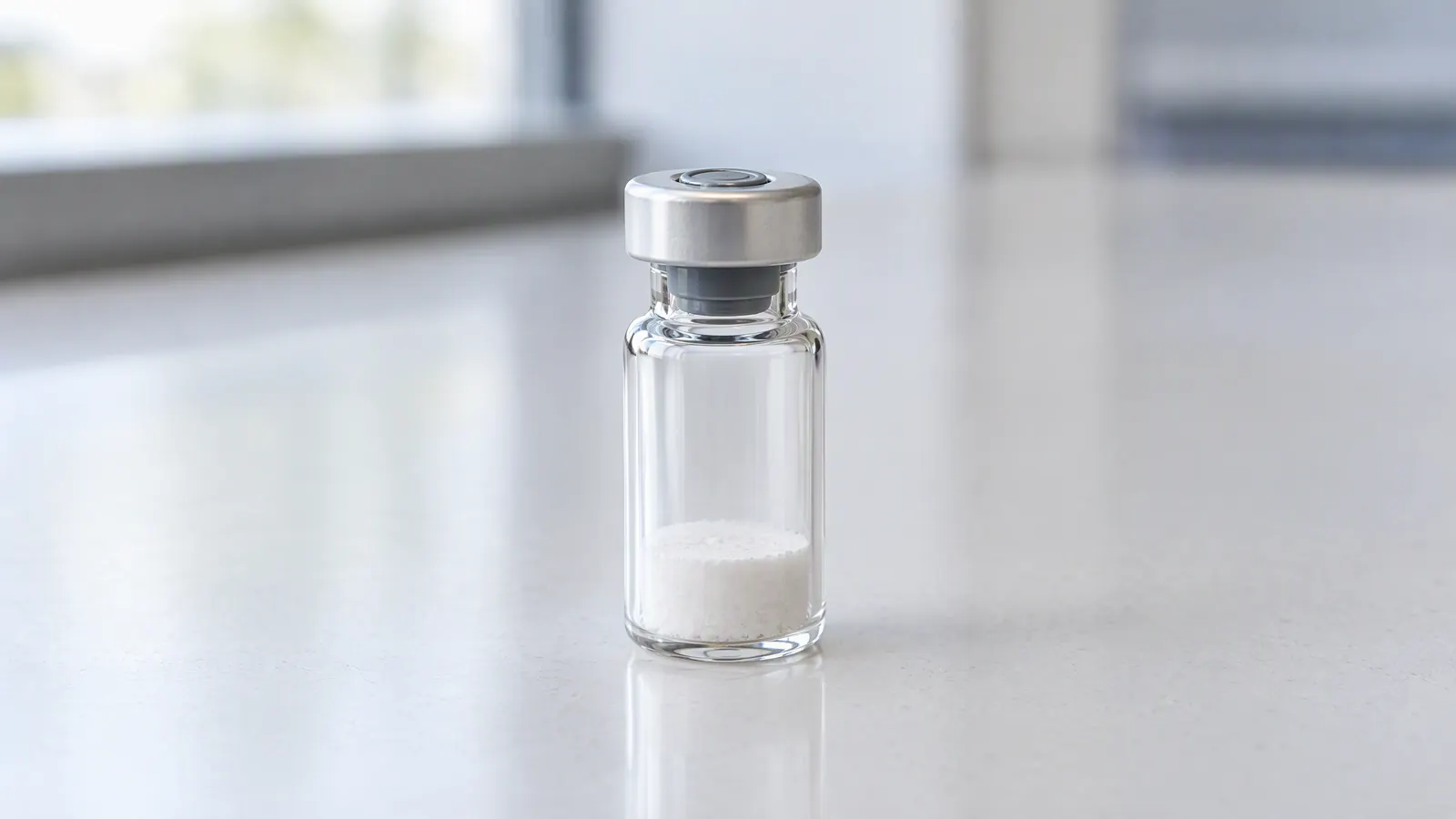
Because the sequence has been public since 2022, contract peptide manufacturers can synthesise retatrutide, and research-use-only suppliers sell it to laboratories as lyophilised powder with a certificate of analysis. That material is not the pharmaceutical-grade drug used in the trials, and it is not for human use.
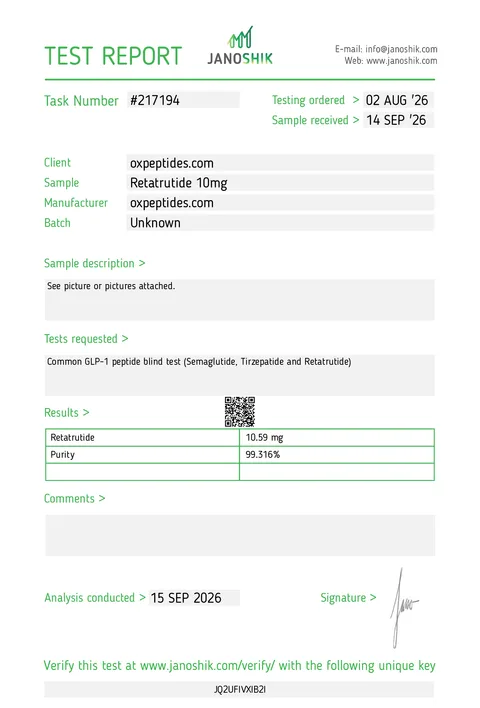
What separates a serious supplier from the rest is documentation: a certificate for each size sold, naming the testing laboratory, with identity by mass spectrometry, purity by HPLC and net peptide content. We explain how to read one, line by line, in how to read a retatrutide COA.
The full vendor comparison, with the tier list and the proof table, is on our page where to buy retatrutide, and what a 10 mg vial costs at each vendor is on retatrutide price.
For laboratories, the retatrutide listing at OXpeptides (sold as RP) ships to Europe, Switzerland included, from the EU, with a public Janoshik report for each size, verifiable by key (the 10 mg vial measured 10.59 mg at 99.316 % purity): See RP (retatrutide) at OXpeptides.
OXpeptides is operated by OX RESEARCH LTD, company number 17464288, which also publishes this site; we say so here rather than pretending otherwise, and the trial figures above do not depend on it.
What we still do not know
- Safety beyond 104 weeks: the longest announced follow-up ends there
- Whether the early heart-rate rise matters: the outcomes trial reports around 2029
- How much of the body-weight change is muscle: body-composition substudies are pending
- What happens after stopping: no off-drug follow-up has been published
Glossary
| Term | Meaning |
|---|---|
| Reta | Short for retatrutide, used on forums and in search |
| GLP-3 | Nickname counting the three receptors; no such hormone exists |
| Triple agonist | One molecule activating GIP, GLP-1 and glucagon receptors |
| TRIUMPH | Lilly's phase 3 program: four trials reported by July 2026 |
| COA | Certificate of analysis: a lab report on one lot |
Glossary
Methods and limits
This page summarises published sources only, checked at the last update: the discovery paper[1], the phase 1b and phase 2 trials[2][3][4][5], Lilly's TRIUMPH releases[6][8][9] and the ClinicalTrials.gov records[7][10]. Each result is given with its trial, dose, number of participants and duration where the source states them.
Limits: the phase 3 results are toplines from press releases, not peer-reviewed papers; figures from different trials are not head-to-head comparisons; the longest announced follow-up is 104 weeks, and the outcomes trial runs to about 2029. The vendor ranking is our own grid, applied to what each vendor's public pages showed on the day they were read.
Questions readers ask
What is the reta peptide?
Reta is short for retatrutide, an investigational once-weekly peptide from Eli Lilly that activates three receptors: GIP, GLP-1 and glucagon. It is also nicknamed GLP-3. It is not approved by any regulator.
What does retatrutide do?
It activates three hormone receptors with one molecule. Through the GLP-1 and GIP receptors it lowers appetite and raises insulin release when glucose is high, and through the glucagon receptor it raises energy expenditure and clears liver fat, according to the discovery paper in Cell Metabolism (2022). It is still investigational.
What is the reta peptide good for?
Trials have measured it on body weight, blood sugar and liver fat.
The 12 mg dose produced −28.3% weight at 80 weeks in phase 3 TRIUMPH-1, HbA1c fell by about two percentage points in the phase 2 type 2 diabetes trial, and liver fat fell by more than 80% at 24 weeks on 8 mg and 12 mg in the phase 2 liver substudy.
It is investigational and has no approved use.
How much does reta peptide cost per month?
There is no monthly price: retatrutide is not approved, so no pharmacy sells it and there is no prescribed dose to cost out. What has a price is the research-use-only vial.
On 21 September 2026, 10 mg vials ranged from $45.49 to $105 among the US vendors that showed a price. These are laboratory reagents, not a treatment cost. Vendor by vendor, with the price per mg: https://retatrutide-peptide.com/retatrutide-price
How much weight did people lose on reta peptide in trials?
Mean weight change was −24.2% at 48 weeks on 12 mg in the phase 2 obesity trial and −28.3% at 80 weeks on 12 mg in phase 3 TRIUMPH-1, against −2.1% and −2.2% on placebo.
Is reta peptide the same as Ozempic or Mounjaro?
No. Semaglutide (Ozempic, Wegovy) acts on one receptor and tirzepatide (Mounjaro, Zepbound) on two. Retatrutide acts on three, adding the glucagon receptor, and is a different, unapproved molecule.
Is reta peptide FDA approved?
No. As of September 2026 retatrutide is investigational. Lilly plans to file with the FDA in the first quarter of 2027, and a standard review takes roughly ten to twelve months after acceptance.
What are the side effects of reta peptide?
Mainly gastrointestinal: in TRIUMPH-1, nausea affected 42.4% of the 12 mg group versus 14.8% on placebo, and 11.3% stopped for adverse events versus 4.9%. Phase 2 also recorded a dose-dependent rise in heart rate.
Where can a laboratory get research-grade retatrutide?
From research-use-only peptide suppliers that publish a certificate of analysis for each size sold. One such listing with a published COA is the retatrutide page at OXpeptides. It is not for human use and this site does not sell anything.